
Dangerous goods buyer guide
UN1866 resin solution air freight: what U.S. industrial buyers should verify before dangerous goods move from China
A practical guide using two real CoronaShield P 8001 / P 8003 photographs and historical shipping documents to explain classification, packing and document control before air freight.
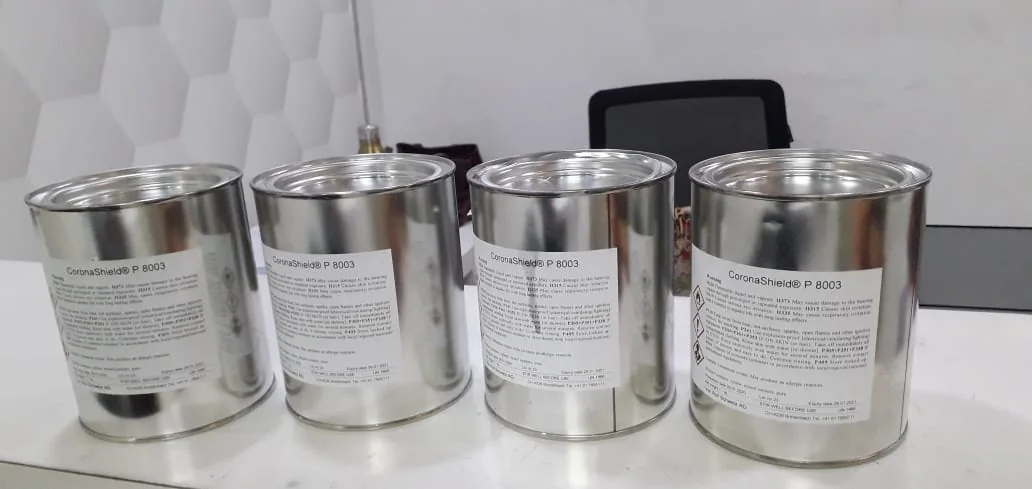
If a resin, coating or insulation material is dangerous goods, price and availability are only the beginning. Before cargo is booked, the exact product, current SDS, UN number, proper shipping name, hazard class, packing group, quantity, permitted package, marks and labels, shipper declaration and airline acceptance must tell the same story. If one item conflicts, stop the shipment and resolve it first.
Search intent this guide answers
Dangerous goods air freight from China is a documentation problem before it becomes a freight problem.
U.S. industrial buyers commonly need answers around UN1866 resin solution shipping, Class 3 flammable liquid air freight, hazmat shipping China to USA, IATA dangerous goods and the Shipper's Declaration for Dangerous Goods. The useful answer is not a list of keywords. It is a release method that prevents the wrong material, wrong packing group or wrong air-freight paperwork from reaching the airport.
Where materials like these are used
Electrical insulation and protective coating applications, but the exact grade must be verified.
The attached CoronaShield P 8003 safety data sheet identifies the material generically as a coating compound / surface coating / paint. Von Roll's current CoronaShield family sits within high-voltage electrical insulation and corona-protection systems used around rotating electrical machines such as motors and generators.
That broader brand use does not prove the exact application of P 8001 or P 8003 in a particular machine. A serious buyer should request the current manufacturer technical data sheet for the exact grade and match it to the approved drawing, process and insulation system before purchase.
What the original P 8003 SDS teaches
One page of transport data can change the entire freight route.
| Product in attached SDS | CoronaShield P 8003, article number 112280 |
|---|---|
| Declared application | Coating compound / surface coating / paint |
| Transport classification shown | UN1866, RESIN SOLUTION, Class 3, Packing Group III for ADR / IMDG / IATA |
| Hazard statements shown | H226 flammable liquid and vapour; H315 causes skin irritation |
| Flash point shown | 30°C |
| Handling / storage lesson | Keep ignition sources away, protect against electrostatic charge, store cool and keep the receptacle tightly sealed |
Why an old DG declaration is useful, but dangerous to copy
The same UN number does not mean every shipment uses the same packing group or packing instruction.
The historical Shipper's Declaration included with this guide contains two separate UN1866 RESIN SOLUTION entries. It shows Class 3, but the entries use different packing groups and different packing instructions. Both were shown as 5 litre fibreboard-box shipments.
This is the lesson for a buyer: never copy a previous declaration simply because the UN number looks the same. Packing group, permitted quantity, passenger or cargo-aircraft status, packaging instruction and airline/operator variation must be checked for the current shipment. In 2026 the applicable IATA DGR edition is the 67th edition, so a 2023 document is an example of document structure, not a 2026 packing authority.
Air-freight packing control
What the buyer should ask to see before a Class 3 package leaves the China warehouse.
- Exact classification: current SDS plus confirmed UN number, proper shipping name, class and packing group.
- Permitted package: packaging selected for the exact classification, net quantity and aircraft route, not a normal export carton chosen only by size.
- Closure and compatibility: inner container, cap or seal, absorbent/cushioning where required, and outer package compatible with the liquid.
- Marks and labels: UN/PSN information, Class 3 hazard label and any orientation, overpack or aircraft marks required for that shipment.
- Photo evidence: photograph containers before packing, the inner arrangement before closing, and the finished outer package after marking and labelling.
- Declaration: have the DG declaration prepared and signed by a properly trained person when required, using current rules.
- Forwarder pre-acceptance: send the SDS, DG details, quantity and proposed packing to the airline/DG forwarder before cargo travels to the airport.
- Destination pre-alert: U.S. importer and receiving forwarder should know the DG classification and document set before departure.
China to USA release sequence
A simple six-step workflow for industrial procurement teams.
Original product photographs
Real product evidence is useful when it is kept inside an honest evidence boundary.

Original documents
See the evidence, but read the note before using it.
What Swiftpath can do
China-side sourcing and export coordination for eligible industrial dangerous goods.
Yiwu Swiftpath can source and coordinate eligible industrial materials from China, including dangerous-goods requirements where a lawful and compliant route is available. This is subject to the exact product, current classification, certified/authorized packing, trained DG preparation, airline or forwarder acceptance and destination-country requirements.
We do not claim Von Roll authorization from these photographs or documents, and we do not present the historical shipment as a Swiftpath export. For a new RFQ, the route starts again from the exact manufacturer, exact grade and current documents.
Have a dangerous-goods industrial RFQ from China?
Send the exact manufacturer/model, quantity, pack size, destination and current SDS if available. We can check the China-side sourcing and DG export route before quotation. WhatsApp: +86 150 5794 2853 • WeChat: A15057942853