
U.S. utility buyer guide
China transformer sourcing for U.S. utilities: verify the OEM, specification and import route before PO
China can be a useful alternative when U.S. transformer lead times are painful, but only after the exact utility specification, real manufacturer, available factory slot, test evidence and U.S. import route are checked together.
The shortage is not solved by finding the first Chinese factory that says “IEEE transformer.” A U.S. buyer needs an exact technical matrix, a real legal manufacturer, a confirmed production slot, auditable test capability, utility acceptance, clean import documents and a route that is commercially legal for that project.
Why U.S. buyers are looking outside normal suppliers
Transformer delay can become the project schedule.
U.S. utilities, EPCs, generators, renewable developers and large-load projects are dealing with long transformer procurement cycles while demand keeps rising. DOE has also identified inconsistent utility specifications and many transformer configurations as part of the supply-chain problem. That means the first useful job is often specification normalization: turn drawings, schedules, IEEE references, accessories and owner requirements into one comparison matrix before asking factories for “equivalent” offers.
First, define the equipment correctly
What is a high-voltage power transformer, and where is it used?
There is no useful purchasing shortcut called simply “high voltage transformer.” For an RFQ, the buyer should state the actual primary and secondary voltage, MVA, BIL, frequency, vector group, impedance, cooling, tap range, losses, bushings, accessories, site conditions and testing requirements.
In practical utility work, large power transformers step voltage up at generating stations or change voltage levels inside transmission and major substations. They are also required for renewable interconnections, large industrial loads and data-center grid connections. A generator step-up transformer, substation autotransformer and distribution transformer are different procurement problems and should not be mixed into one specification.
Where China can help
China is an alternate capacity pool, not an automatic shortcut.
A capable Chinese OEM can offer another production route, competitive manufacturing, engineering resources and a large electrical-equipment supply base. But “China has capacity” is not the same as your exact transformer has an available slot. We would ask the factory for the earliest unallocated slot for the exact design and request a written deviation list before price becomes the main discussion.
How to find the real Chinese OEM
A factory website is evidence of marketing. It is not evidence of legal identity or transformer capability.
We start with the Chinese legal name and Unified Social Credit Code, then match the business registration against the quotation, bank beneficiary and factory address. We check whether the entity is a manufacturer or only a trading route, then review the transformer range, production equipment, engineering team, testing facilities, relevant references and export-document capability.
For Chinese legal registration we use the National Enterprise Credit Information Publicity System. For China-issued certification or accredited laboratory claims, we use the competent public registry such as CNCA or CNAS where applicable. For U.S. or international certificates, the correct issuing or accreditation database must be checked instead. We do not call a PDF “verified” only because it has a logo and stamp.
A supplier sends a genuine ISO certificate whose scope covers “10 kV distribution transformers,” while your RFQ is for a 230 kV, 200 MVA power transformer. The certificate may be authentic and still be almost useless for proving that factory can design, manufacture and test your required unit. We then ask for transformer-specific design scope, relevant type/routine test evidence, laboratory capability, comparable voltage/MVA references and the exact legal entity behind those records.
What U.S. rules actually mean
Do not mix DOE law, CBP import rules, IEEE standards and project-specific Buy America requirements.
What should be inspected before release?
Transformer FAT is not one photograph beside the tank.
The inspection plan should follow the approved specification and applicable test code. For liquid-immersed power transformers, IEEE C57.12.90 covers methods including resistance, ratio and phase relation, no-load loss and excitation current, impedance and load loss, dielectric, temperature, short-circuit and sound-level testing. The exact witnessed tests still depend on the contract and transformer type.
- Identity: legal manufacturer, project serial number, nameplate data and approved drawing revision.
- Design conformity: voltage, MVA, vector group, impedance, taps, BIL, cooling, bushings and accessories.
- Test evidence: routine/type/special tests as contractually required, with traceable reports and calibrated equipment.
- Physical inspection: dimensions, workmanship, radiators, conservator, marshalling cabinet, OLTC route, valves, gauges and shipment accessories.
- Packing: moisture control, impact/tilt indicators where specified, nitrogen/oil transport condition, loose accessory identification and heavy-lift marking.
- Release file: approved deviation list, FAT reports, drawings, manuals, packing list, commercial invoice and transport documentation.
Why physical presence matters
We do visit Chinese manufacturers in person.
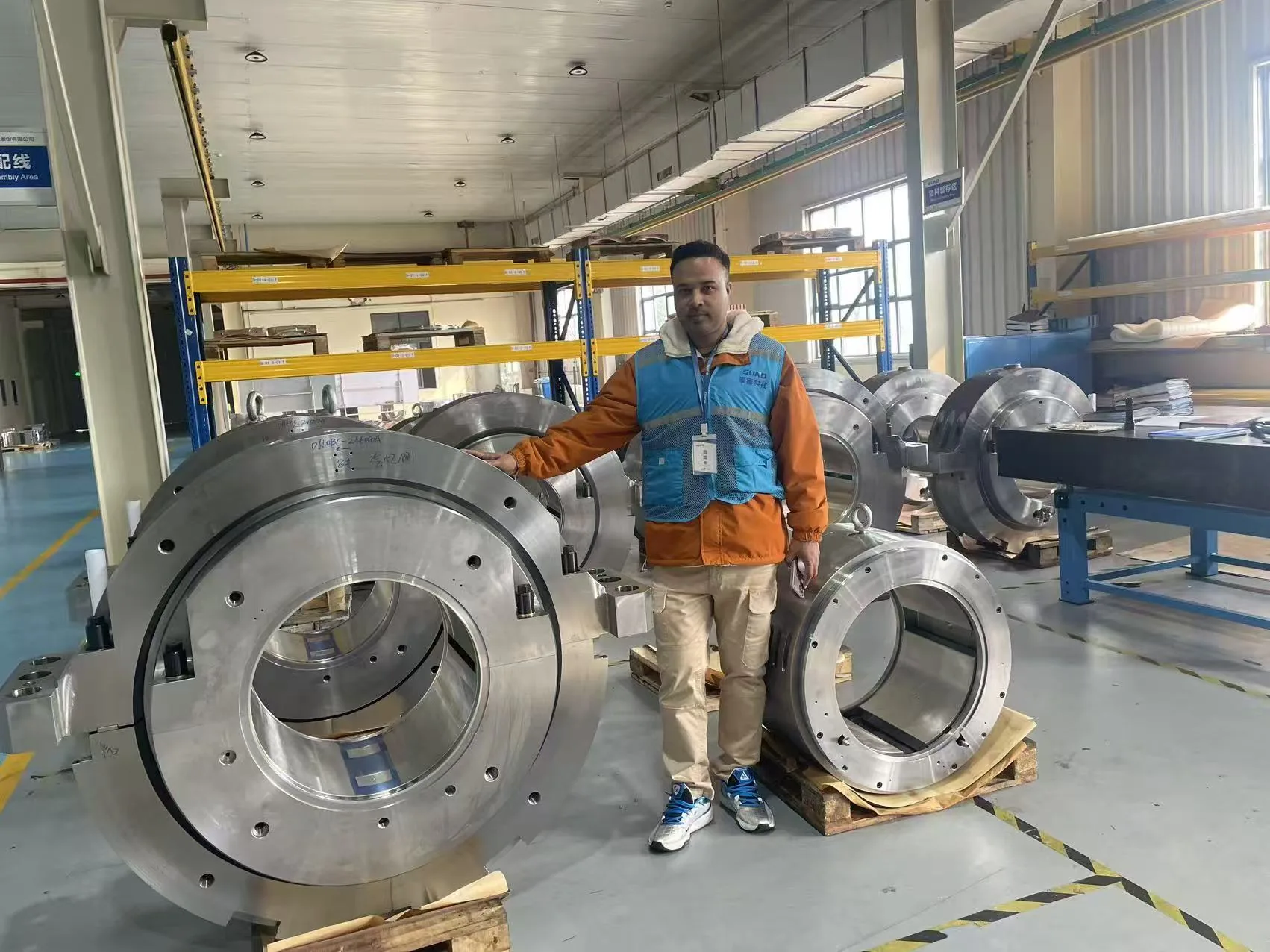
Document screening can be done remotely, but critical orders may need a real factory visit. In one CCPP thrust and radial bearing-housing project, our team visited the Chinese OEM before purchase and again during delivery-stage inspection. We reviewed the manufacturer environment, bearing components, large housings and dimensional inspection equipment in person.
This was not a transformer project. We show it because the same procurement principle applies: the buyer should be able to connect the legal entity, factory, physical product, inspection evidence and final shipment.


10-second field proof
Actual factory-visit photographs, not stock footage.
The short player below uses our own CCPP bearing-project inspection photographs. For more field evidence and project videos, visit our YouTube channel.
Visit Yiwu Swiftpath Global on YouTubeWhat Swiftpath can do for a transformer RFQ
We act as a China-side control point, not the U.S. engineer of record.
FAQ
Questions U.S. buyers should ask before giving us the project.
Can Swiftpath visit the transformer manufacturer in person?
Yes. We can visit a Chinese manufacturer in person when the project scope and location make it practical. We can verify the factory identity, manufacturing environment, project-specific production evidence and agreed inspection points. Final engineering acceptance remains with the buyer or its appointed engineer.
We are very certificate driven. How will you assure the documents are real and relevant?
We verify the legal entity first, then the certificate. Chinese company registration is matched through the official enterprise registry. China-issued certification and laboratory-accreditation claims are checked through the competent CNCA/CNAS or issuing-body route where applicable; U.S. or international certifications are checked through the relevant issuer database. We also verify scope. A genuine certificate for 10 kV distribution transformers does not prove capability for a 230 kV, 200 MVA power transformer.
Can you arrange export from China too?
Yes. We can coordinate export documents, freight and shipment execution from China. DDP can also be considered case by case, but only after the U.S. importer/broker route, duties, trade measures, country-of-origin requirements and project eligibility are confirmed.
Can you guarantee that a China transformer will be accepted by our utility?
No responsible sourcing company should promise that before engineering review. We can build the compliance/equivalency file, identify deviations, verify the factory and support inspection. The utility or its authorized U.S. engineer makes the final technical acceptance.
What should we send for the first review?
Send the transformer schedule, single-line diagram, voltage/MVA, BIL, impedance, cooling, tap requirements, loss limits, accessory list, IEEE/utility standards, site conditions, required tests, delivery target and any existing vendor offer. We can then identify what is fixed, what is negotiable and what China factory evidence must be produced.
Official reference points
Rules and standards the buyer should check at project stage.
This article is procurement education, not U.S. legal, customs or professional-engineering advice. Requirements can change by transformer type, HTS classification, project funding, utility specification and shipment date. Verify the current rule set for each transaction.
Have a transformer RFQ or a supplier offer from China?
Send the specification, drawing, required standards, delivery target and existing quotation. We can first identify the risk points and the evidence a real OEM must produce. WhatsApp: +86 150 5794 2853 • WeChat: A15057942853